

SSC Leadership

SYSTEMIC TEAM INTELLIGENCE
What the Team Knows But Cannot Say Is Already Shaping Performance
Leadership teams are often more capable than their results suggest. When the same tensions keep returning, collaboration weakens under pressure, or accountability remains a conversation rather than a reality — the issue is rarely individual performance. It is usually something operating below the level of strategy and structure.
Systemic Team Intelligence

Leadership Team Facilitation for Senior Leaders in Singapore and Southeast Asia
Systemic Team Intelligence is a facilitation approach designed for senior leadership teams and organizations where recurring tensions, fragmented alignment, or stalled execution point to something operating below the surface. It is used by CHROs, HR directors, and organizational leaders across Singapore, Indonesia, Malaysia, and Vietnam when conventional team development, culture programmes, and leadership training have not produced lasting change.
ORGANIZATIONAL PATTERNS
What Systemic Team Intelligence addresses
Recurring team tensions that resurface despite previous interventions
Collaboration weakening precisely when pressure increases
Many organizations continue investing in strategy, restructuring, leadership development, and culture initiatives — yet certain tensions continue returning in different forms.
Leadership teams carrying unspoken tensions that affect performance
Accountability gaps where ownership is discussed but not enacted
Cultural friction following mergers, acquisitions, or leadership transitions
What looks like a performance or communication issue is often something older and less visible — a pattern the organization has carried for years.
Increasing caution in leadership conversations where directness is needed
Alignment that fragments under organizational pressure or change
Leaders who sense something is off but cannot locate the source — or agree on what to address first
ORGANIZATIONS
Teams We've Worked With
Organizations from a range of industries have engaged this work — including precision engineering, pharmaceutical, financial services, technology, and food processing sectors. In each case, the presenting challenge, poor collaboration, stalled execution, cultural friction, had already been discussed. What was needed was a different kind of visibility.

THE WORK
How Systemic Team Intelligence Works
This work helps leadership teams surface the hidden dynamics affecting trust, alignment, decision-making, and execution.
Rather than focusing only on visible problems, the work explores the deeper patterns shaping how the organization moves, collaborates, and responds under pressure.
The goal is not better frameworks or clearer plans. It is restoring the conditions under which leadership teams naturally move with coherence, trust, and shared ownership. Much of this work is done through systemic constellations — a facilitation method that makes the team's underlying structure visible in the room, rather than described in the abstract
Clarify tensions affecting collaboration
Restore coherence around ownership and authority
Strengthen collective alignment and movement
Facilitated by Leksana TH, ICF PCC NCC — with three decades of experience working with leadership teams and organizations across Singapore and Southeast Asia.

PROPRIETARY INTELLIGENCE TOOL
Make the Invisible Dynamics
in Your Organization Visible
SSC SYSTEMIC DIAGNOSTIC MAPPING TOOL · VERSION 1.0
Complex leadership challenges often resist conventional analysis. The SSC Systemic Diagnostic Mapping Tool makes invisible dynamics visible, mapping the patterns, tensions, and relational dynamics that shape how a team makes decisions, distributes ownership, and responds under pressure, dynamics that conventional diagnostics rarely surface.
Explore complex issues at the individual, team, or organizational level through live systemic constellation mapping.
Surface the patterns — fragmented ownership, avoided conversations, and recurring friction — that conventional diagnosis does not reach.
Available in-person or online — facilitated by Leksana TH, systemic facilitator and ICF PCC.
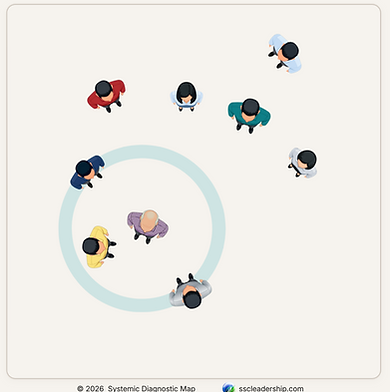
SSC SYSTEMIC DIAGNOSTIC MAPPING TOOL · V1.0
© 2026 SSC LEADERSHIP

WAYS TO BEGIN
Ways to Begin a Systemic Team Engagement
Each engagement begins with a confidential conversation about what is happening in your organization — without obligation. For organizations ready to explore the dynamics in more depth, the Systemic Leadership Session — a focused two-hour facilitation — is the most direct starting point. All options below can be discussed during an initial call.
02
FOCUSED EXPLORATION
A focused two-hour session that surfaces the primary dynamics affecting leadership alignment, trust, or execution — and gives the team a clearer sense of what to address and why.
2 HOURS · ONLINE OR IN-PERSON
03
LEADERSHIP DIAGNOSTIC
Systemic Deep Dive
A half-day to full-day diagnostic that combines cultural and leadership assessment data with live systemic facilitation — giving leadership teams both a measurement baseline and deeper organizational visibility.
Barrett Values Cultural Assessment
Collective Leadership Assessment (LCP CLA)
Systemic Team Diagnosis
HALF-DAY TO FULL DAY · IN-PERSON PREFERRED
04
LEADERSHIP RETREAT
Systemic Alignment Retreat
A two-day retreat to help top teams surface hidden tensions, strengthen collective alignment, and renew organizational coherence.
Day 1
Systemic diagnosis and team exploration.
Day 2
Reconnection, realignment, and renewal.
2 FULL DAYS · RESIDENTIAL OR OFFSITE

SELECTED SITUATIONS
Where the Work Made a Difference
These situations share a common pattern: capable leaders, genuine effort, and a problem that kept returning. Systemic work became relevant when everything reasonable had already been tried.
PRECISION ENGINEERING
When Heritage Blocked Transformation
Regional VP People & Culture · Global Precision Engineering
A market leader in high-precision manufacturing faced a stalled transition toward a digital ecosystem. Despite strategic clarity, the leadership team remained divided — with no obvious cause. Systemic mapping revealed that the firm's seventy-year legacy of technical craftsmanship was being held as an unconscious loyalty. For senior leaders, the digital shift felt like a disavowal of what had made the organization exceptional. Once visible and acknowledged, resistance softened — and energy previously spent defending a legacy became available for leading an evolution.
SPECIALTY SCIENCE & MATERIALS
When Integration Never Fully Landed
CHRO · Global Specialty Science & Materials
Two years after a complex global merger, this science-based organisation continued to experience decision paralysis and cultural friction — despite alignment workshops and genuine leadership goodwill. Systemic exploration revealed the system was still carrying loyalty to a legacy entity that had been dissolved but never acknowledged. The work invited leaders from both histories to name what had been lost and what each legacy brought as a contribution to the new whole. Decision-making accelerated. Collaboration improved without being managed. The burden of the merger was replaced by a shared sense of direction.
PUBLIC-PRIVATE INNOVATION
When Governance Slowed Change
Director of Transformation · Public-Private Innovation
A high-stakes organization bridging public health and emerging technology faced persistent innovation roadblocks. Frameworks were sound. External support was in position. Yet the initiative kept stalling. Systemic mapping revealed a conflict at the identity level: the organization's historical order was built on risk aversion and hierarchy, while the new mandate required emergence and distributed ownership. Leaders were paralyzed — not from lack of capability, but because they did not know how to belong to the new way of working. The facilitation shifted focus from solving the problem to understanding what the organization was still organized around. Ownership increased. Execution began moving with coherence.
LEADERSHIP TEAM OUTCOMES
What Leaders Noticed
The process helped our leadership team surface tensions we had been managing around for years but rarely addressed directly. Once the dynamics became visible, conversations became clearer, decisions moved faster, and accountability improved naturally.
Precision Engineering
Regional VP of People and Culture
What surprised us most was not the insight itself, but how quickly the atmosphere changed once certain realities were openly acknowledged. The team became less reactive, more collaborative, and significantly more aligned.
Global Pharmaceutical
Human Capital Partner
The session helped us reconnect strategic direction with leadership ownership across the organization. What had previously felt fragmented began moving with much greater coherence.
Food Processing
CEO
The work gave us language and visibility around patterns we had sensed for years but could never fully articulate. It changed how we approached both leadership conversations and organizational decisions.
High Technology Sector
Business Development Director
It brought a level of clarity and collective understanding that traditional alignment discussions had not been able to produce. The impact continued well beyond the session itself.
Energy Company
Head of Talent Development
WHERE TO BEGIN
The pattern your team keeps returning to has a source. A single conversation can begin to locate it.
The 20-minute Explore Call is a confidential conversation about what is happening in your organization — and whether a systemic lens may help bring greater clarity or movement.
The most expensive problems in organizations are rarely structural. They live in the space between people — in what is sensed but not said, carried but not named. That is precisely where this work begins.